Research Article | | Peer-Reviewed

Computational Elucidation of Novel Synthetic Scheme for Dasatinib

Received: 27 January 2025     Accepted: 11 February 2025     Published: 26 February 2025
Views:       Downloads:
Abstract

The Novel route of investigation for the application of Quantum chemistry to clarify the new synthetic route for Dasatinib from (E)-Ethyl-3-ethoxy acrylate by using various reagents. The Overall Reaction carried out in Eight Steps. Which are less than earlier reported synthetic schemes. The Energy of every reactant, Intermediate and products were calculated by using DFT (Density Functional Theory). The energies diagram obtained shown the new proposed scheme could follow the easy path to obtain the product, moreover, the energy barrier required to overcome the transition state is low indicating, very less activation energy is required for every reactant to take part in chemical reaction. The energy diagram that was obtained shows that the new plan that was suggested could follow an easy path to obtaining Product.

Published in International Journal of Computational and Theoretical Chemistry (Volume 13, Issue 1)
DOI 10.11648/j.ijctc.20251301.11
Page(s) 1-12
Creative Commons

This is an Open Access article, distributed under the terms of the Creative Commons Attribution 4.0 International License (http://creativecommons.org/licenses/by/4.0/), which permits unrestricted use, distribution and reproduction in any medium or format, provided the original work is properly cited.

Copyright

Copyright © The Author(s), 2025. Published by Science Publishing Group

Keywords

Dasatinib, Quantum Chemistry, Transition State, Density Functional Theory (DFT), Cyclization, Halogenation, Quantum Chemistry (QM), Regioselective Demethylation

1. Introduction
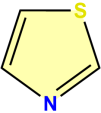
Dasatinib is a thiazole scaffold drug. Thiazole is a five-membered heterocyclic molecule distinguished by a ring structure including one Sulphur atom and one nitrogen atom, located at positions 1 and 3. The chemical formula is C3H3NS. It is acknowledged for its notable aromatic characteristics resulting from the delocalization of electrons in the ring. Thiazole is distinguished by its pale-yellow liquid state and pyridine-like aroma . The thiazole ring demonstrates significant aromaticity, which is attributed to a 6π-electron system, hence augmenting its stability and reactivity. The planarity of the thiazole structure facilitates substantial π-electron delocalization, rendering it an essential element in several biological compounds.
Figure 1. Structure of 1, 3-Thiazole.
Thiazoles are renowned for their varied pharmacological properties. They function as scaffolding for several clinically authorized pharmaceuticals, demonstrating actions including antibacterial, antifungal, antiviral, antitumor, and anti-inflammatory properties. It is present in naturally occurring peptides and employed in the synthesis of peptidomimetics (i.e., compounds that replicate the function and structure of peptides). Thiazole derivatives have implications in the treatment of several illnesses, such as infections from multi-drug-resistant bacteria, Alzheimer's disease, and metabolic syndrome. For example, substances such as alpelisib are utilized in the treatment of particular cancer types, whilst others like thiabendazole serve as antiparasitic drugs. In agriculture, thiazole derivatives are used as fungicides and pesticides, the nucleus target specific agricultural pests .
General Methods for Synthesis of Thiazole
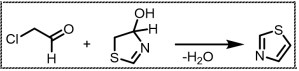
The synthesis of thiazole encompasses many known methods, each employing distinct reactants and conditions to construct the thiazole ring. Some of the common synthetic pathways are Hantzsch Thiazole Synthesis (Schemes 1-3), Cook-Heilbron Synthesis, Gabriel Synthesis (schemes 1-3) and microwave-assisted synthesis .
Scheme 1. Hantzch method for thiazole synthesis.
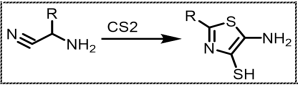
Scheme 2. Cook-Heilbron method for thiazole synthesis.
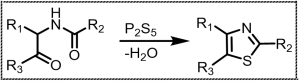
Scheme 3. Gabriel method for thiazole synthesis.
Biosynthesis of thiazole involves cysteine, which contributes the N-C-C-S framework of the ring. Thiamine, however, does not conform to this pattern. Multiple biosynthetic pathways culminate in the thiazole ring essential for thiamine production. The sulfur in thiazole originates from cysteine. In anaerobic bacteria, the cyanide group is generated from dehydroglycine . When thiazoles are alkylated at nitrogen, a thiazolium cation is created. these cations serve as catalysts in various named reactions such as Stetter reaction and the Benzoin condensation .
Literature Review of Dasatinib
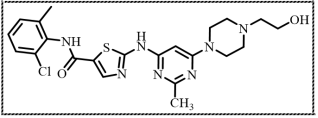
Dasatinib
Figure 2. Structure of N- (2- chloro -6 -methylphenyl)- 2-((6- (4- (2-hydroxyethyl)piperazin-1-yl)-2-methylpyrimidin-4-yl)amino)thiazole-5-carboxamide.
Dasatinib is a medication primarily approved by US-FDA in 2006 for the treatment of certain types of leukemia i.e. chronic myelogenous leukemia (CML) and acute lymphoblastic leukemia (ALL) . Recently, it has been approved to treat specific type of Philadelphia chromosome-positive leukemia as well. It works as a tyrosine kinase inhibitor, by inhibiting the activity of enzymes involved in cancer cell growth .
Reported Synthetic Routes for the Synthesis of Dasatinib
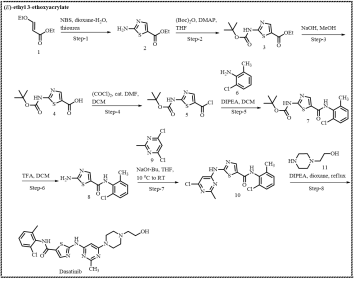
Bristol-Myers Squibb, USA has disclosed an eight steps novel and efficient synthetic route (Scheme4) for the synthesis Dasatinib and their intermediates. The step-1 involves the chemo selective α-bromination (using NBS) of β-ethoxyacrylamide, 1 which on further treatment with thioureain one-pot reaction cyclized to give ethyl 2-aminothiazole-5-carboxylate, 2. The nucleophilicity of the primary amine was reduced by protecting it with boc anhydride under basic (e.g. DMAP) condition to give ethyl 2-((tert-butoxycarbonyl)amino)thiazole-5-carboxylate, 3. Hydrolysis of ester (3) and chlorination of formed acid 2-((tert-butoxycarbonyl)amino)thiazole-5-carboxylic acid, 4 were carried out sequentially which offered tert-butyl (5-(chlorocarbonyl)thiazol-2-yl)carbamate, 5viastep-3 and step-4. tert-butyl (5-((2-chloro-6-methylphenyl)carbamoyl)thiazol-2-yl)carbamate, 7 was formed by amidation of 5 with 2-chloro-6-methylaniline, 6which further undergoes bocdeprotection which gave 2-amino-N-(2-chloro-6-methylphenyl)thiazole-5-carboxamide,8. Finally, two consecutive nucleophilic aromatic substitution’s (SNAr’s) as depicted in step-7 and step-8 offered N-(2-chloro-6-methylphenyl)-2-((6-(4-(2-hydroxyethyl)piperazin-1-yl)-2-methylpyrimidin-4-yl)amino)thiazole-5-carboxamide, Dasatinib .
Scheme 4. Novel synthetic route reported by Bristol-Myers Squibb, USA.
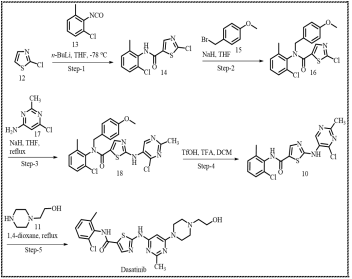
Louis J. Lombardo et al., discovered a new synthetic route (Scheme 5) for the synthesis of Dasatinib. The route mainly involves five steps, starting with the lithiation of 2-chlorothiazole (12) and its condensation with 2-chloro-6-methylphenyl isocyanate (13) to give 2-chloro-N-(2-chloro-6-methylphenyl) thiazole-5-carboxamide (14) via step-1. Formed carboxamide, 14 was protected through 4-mehoxybenzyl derivative (15) in step-2 to give 2-chloro-N-(2-chloro-6-methylphenyl)-N-(4-methoxybenzyl)thiazole-5-carboxamide, 16 which on nucleophilic aromatic substitution (SNAr) reaction (step-3) with 4-amino-6-chloro-2-methylpyrimidine (17) formed 2-((4-chloro-2-methylpyrimidin-5-yl)amino)-N-(2-chloro-6-methylphenyl)-N-(4-methoxybenzyl) thiazole-5-carboxamide (18). Following deprotection of 4-methoxybenzyl group of compound 18 under acidic condition (TfOH:TFA in DCM; step-4) offered 2-((4-chloro-2-methylpyrimidin-5-yl)amino)-N-(2-chloro-6-methylphenyl)thiazole-5-carboxamide, 10 which on SNAr reaction with 2-(piperazin-1-yl)ethan-1-ol (11) gave final compound Dasatinib through step-5. Formed final compound was converted into its hydrochloride salt with methanolicHCl in ether .
Scheme 5. Robust and scalable synthetic route reported by Louis J. Lombardo et al.
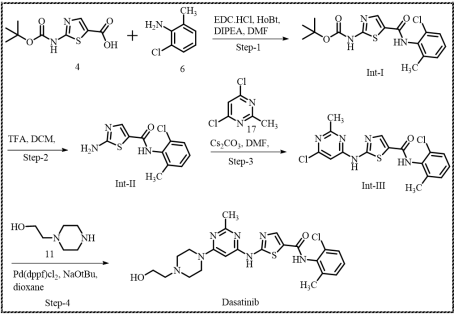
Proposed Novel Scheme for the Synthesis of Dasatinib
Scheme 6. Proposed robust and scalable synthetic route for the Dasatinib.
Theory and Hypothesis
The documented synthesis pathway for Dasatinib comprises 4 to 8 stages including multiple intricate reactions. These reaction methods are time-consuming and use chemicals as raw ingredients. The yield of the above approaches is likewise modest. Considering this, we suggest a unique 4 step method having luxury of both cost-effectiveness and a higher yield. The technique outlined above consists of two steps: Acid-amine coupling, Boc-deprotection, Nucleophilic aromatic substitution and Buchwald coupling reactions, the reagents to be utilized in reactions are summarized in Table 1.
Table 1. Reagents and reactants used in the reaction.

EDC

1-Ethyl-3-(3-dimethylaminopropyl) carbodiimide

HCl

Hydrochloric acid

HOBt

Hydroxy benzotriazole

Pd(dppf)Cl2

[1,1'-Bis(diphenylphosphino) ferrocene] dichloropalladium(II)

NaOtBu

Sodium tert-butoxide

NaCl

Sodium chloride

Computational Details
Computing the energies of all possible intermediates and transition states using the B3LYP/6-311+G(d,p) basis set in the Gaussian-09 suite validates the suggested approach. The chemical characteristics of all substances were obtained using basis sets that contained both d and double polarized orbitals. In terms of both accuracy and computing cost, the basis set that was employed is ideal. Locating a single negative eigen value allows for the identification of transition stages. By doing single-point computations at the MP2 level, the electronic energies of the structures that are produced are reinterpreted. The beginning point structures were not subjected to symmetrical restrictions when minimization was being performed. An electrophile's lowest unoccupied molecular orbital (LUMO) and a nucleophile's highest occupied molecular orbital (HOMO) meet in a chemical reaction. A nucleophile's ability to donate electrons is determined by the energy of its HOMO, whereas an electrophile's ability to accept electrons is determined by the energy of its LUMO. Stronger interactions, brought about by an increase in the overlap and closeness of energy levels among these orbitals, accelerate reaction rates . During the computation, all other parameters were left at their default values. The energy was displayed graphically.
2. Result and Discussion
Possible Mechanism in the Synthesis of Dasatinib
Step-1: Acid-amine coupling
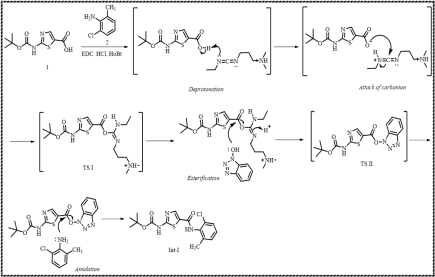
In the first step (Scheme 7), the imine 1-Ethyl-3-(3-dimethylaminopropyl)carbodiimide (EDC. HCl)deprotonates the proton of 2-((tert-butoxycarbonyl)amino)thiazole-5-carboxylic acid (1). Nucleophilic attack by the carboxylate carbanion formstwo consecutive intermediates TS-1and TS-2 which ultimately converts oxygen to a good leaving group and after an addition-elimination, a product amidetert-butyl (5-((2-chloro-6-methylphenyl)carbamoyl)thiazol-2-yl)carbamateInt-Iwould be formed .
Scheme 7. Formation of Intermediate-I (Int-I).
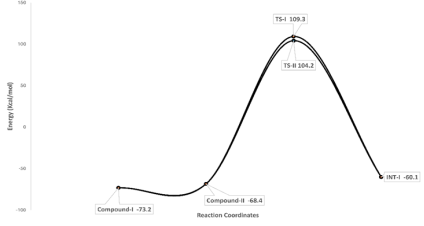
The formation of Int-I form the starting material generates two transition states possessing the energy of 109.3 Kcal/mol and 104.2 Kcal/mol for TS-I and TS-II. Formation of both the TS states follows endothermic path where large amount of energy is absorbed. The energy gap between TS II and TS I is 5.1 Kcal/mol. The lower energy of TS II indicates the formation of Int I follows the second path as the energy barrier is high for TS I and large amount of energy is required to overcome the same. The Int-I formation is exothermic in nature and release large amount of energy (Figure 3). The distance calculated for the reactant atoms of TS states, and Int-Iwere in the optimal range (Figure 4).
Figure 3. Energy profile diagram for the formation of Int-I.
Step-2: Boc-deprotection
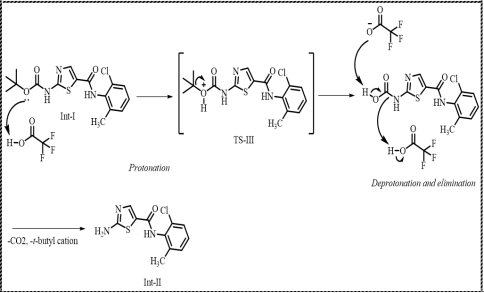
Step-2 (Scheme 8) involves the Boc-deprotection of the Int-I. The tert-butyl carbamate of tert-butyl (5-((2-chloro-6-methylphenyl)carbamoyl)thiazol-2-yl)carbamate, Int-Iwould be protonated by trifluoroacetic acid and forms the TS-III. The loss of the tert-butyl cation from TS-1 will results in a formation of carbamic acid which would undergo decarboxylation to form the free amine2-amino-N-(2-chloro-6-methylphenyl)thiazole-5-carboxamide, Int-II. As deprotection reaction performed in acidic condition, the amine product will be precipitated as FA salt (Scheme 8) .
Scheme 8. Formation of Intermediate-II.
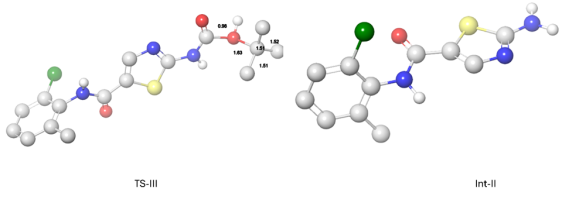
Figure 5. Optimal atomic distance between the reactant atoms in TS-III and Int-II.
Step-3: Nucleophilic aromatic substitution (SNAr)
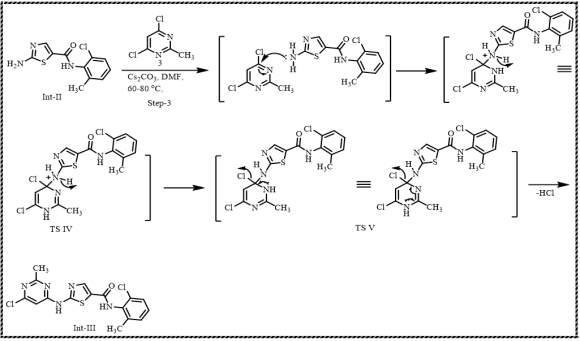
The third step (Scheme 9) is a nucleophilic aromatic substitution between Int-II and 4,6-dichloro-2-methylpyrimidine to form 2-((6-chloro-2-methylpyrimidin-4-yl)amino)-N-(2-chloro-6-methylphenyl)thiazole-5-carboxamide, Int-III, Scheme 9. SNAr reaction mainly initiated by attack of the nucleophile (Int-II) on the electron-poor ring (3) which generate a negatively charged “Meisenheimer” intermediate, as indicated in rate-limiting steps TS-IV and TS-V. The formed transition step collapse to expulse leaving group to form Int-III .
Int-I reacts with trifluoro acetic acid and undergo protonation to form TS III, which upon deprotonation and elimination of CO2 result in the formation of Int-II. The reaction proceeds with the formation of only one transition state having energy of 101.3 Kcal/mol, from the formed TS, INT formation releases the energy of 163.3 Kcal/mol. Int-II generates two Transition states, TS IV and TS V (resonating structure) before converting into Int-III. The energy of TS V is quite less than that of TS VI indicating the favorable path for the formation of Int-(Figures 5, 6) The distance calculated for the reactive atoms were found to be in range of bond cleavage and bond formation (Figure 7).
Scheme 9. Formation of Intermediate-III.
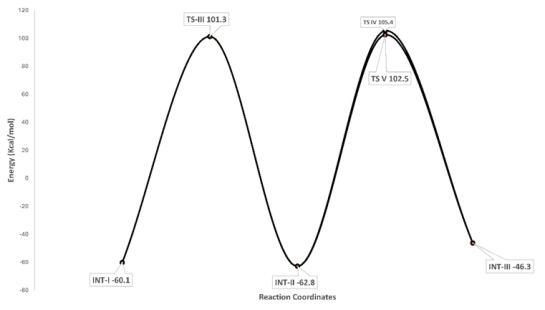
Figure 6. Potential energy profile diagram for the formation of Int-II and Int-III.
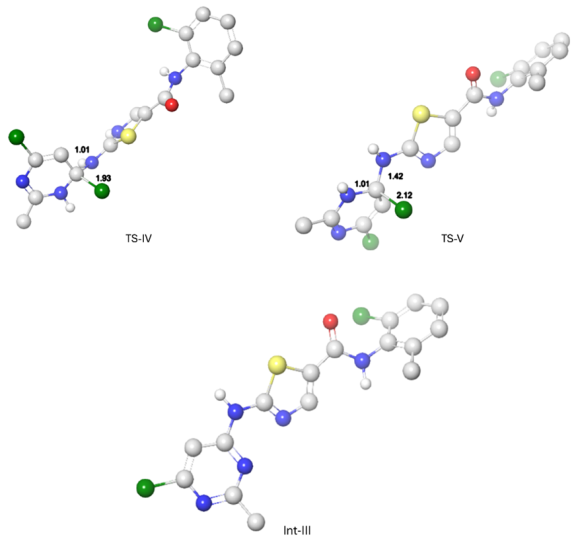
Figure 7. Optimal atomic distance between the reactant atoms in TS-IV, TS-V and Int-III.
Step-4: Buchwald coupling
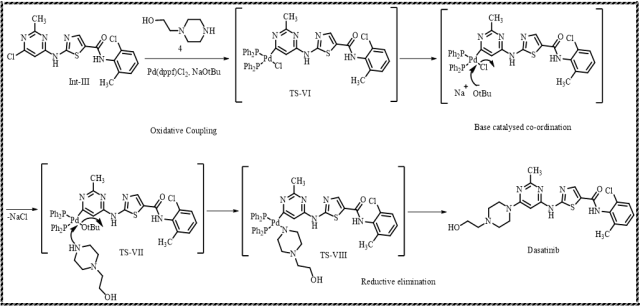
The final step (Scheme 10) as per the proposed synthetic route for Dasatinib is buchwald coupling reaction between 2-((6-chloro-2-methylpyrimidin-4-yl)amino)-N-(2-chloro-6-methylphenyl)-thiazole-5-carboxamide, Int-III and 2-(piperazin-1-yl)ethan-1-ol, 4. In the coupling cycle, first Pd(II) in Pd(dppf)Cl2 will be reduced to Pd(0) by amines that contain α-H or ligand
Scheme 10. Formation of Dasatinib from Int-III.
Once catalyst is activated it kicks one ligand off and undergoes oxidative addition to form Pd(II) complex as depicted in TS-VI. Next, 2-(piperazin-1-yl) ethan-1-ol, attack Pd in TS-VI, and further forms two consecutive transition states as TS-VII and TS-VIII. In the final step, product N-(2-chloro-6-methylphenyl)-2-((6-(4-(2-hydroxyethyl)piperazin-1-yl)-2-methylpyrimidin-4-yl)amino)thiazole-5-carboxamide, Dasatinib would be formed through reductive elimination process and coupling cycle will complete .
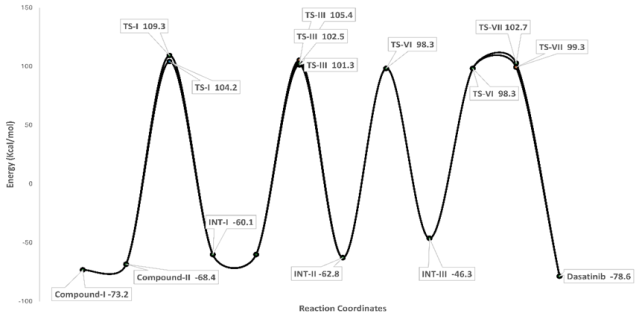
In the final step Int-III react with NaOtBu and generates three transition states viz; TS -VI, TS VII, TS VIII which then undergo rearrangement to form Dasatinib. The energy for TS VI (98.3 Kcal/mol) is less than that of TS VII (99.3 Kcal/mol) and TS VIII (102.7 Kcal/mol), finally the compound release energy to form Dasatinib, the reaction is endothermic in nature, represented in full energy diagram (Figure 8). The bond distance for reactive groups is shown in Figure 9.
Figure 8. Over all energy profile diagram for the formation of Dasatinib.
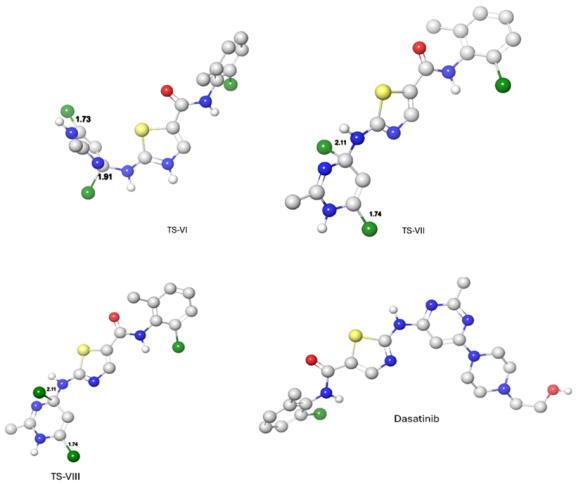
Figure 9. Optimal atomic distance between the reactant atoms in TS-V, TS-VII, TS-VIII and Dasatinib.
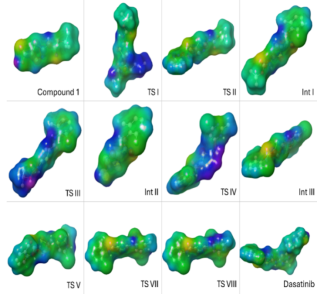
Table 2. Energy profile of Reactant, all transition state and final product.

Serial No

Compound No

Energy (Kcal/mol)

1

Compound-I

-73.2

2

Compound-II

-68.4

3

TS-I

104.2

4

TS-II

109.3

5

INT-I

-60.1

6

TS-III

101.3

7

TS-IV

105.4

8

TS-V

102.5

9

INT-II

-62.8

10

TS-VI

98.3

11

INT-III

-46.3

12

TS-VII

99.3

13

TS-VIII

102.7

14

Dasatinib

-78.6

By determining the border molecular orbitals of some of the significant intermediates and transition states produced during the reaction, a fuller comprehension of the reaction process may be attained. It provides a clear picture of the course a reaction takes till the product is formed. The HOMO and LUMO eigenvalues, which correlate to their energies, may be computed to do this. The final orbital in Gaussian designates the HOMO, whereas the first orbital designates the LUMO. The energy gap is represented by the difference between the eigenvalues of the LUMO and the HOMO.
Energy(gap)=LUMO-HOMO
Table 3. HOMO and LUMO calculation for the compounds, Intermediates and Transition states.

Compounds

HOMO

LUMO

Energy(gap)LUMO -HOMO

compound 1

-0.23554

-0.05918

0.17636

compound 2

-0.19768

0.00252

0.2002

TS I

-0.31743

-0.16193

0.1555

TS II

-0.23902

-0.07729

0.16173

INT 1

-0.22964

-0.05255

0.17709

TS III

-0.30946

-0.18901

0.12045

Int 2

-0.2153

-0.03904

0.17626

TS IV

-0.32895

-0.2031

0.12585

TS V

-0.23375

-0.07

0.16375

INT 3

-0.23177

-0.06553

0.16624

TS VI

-0.32861

-0.191

0.13761

TS VII

-0.22388

-0.0626

0.16128

TS VIII

-0.22386

-0.06257

0.16129

Dasatinib

-0.20967

-0.05586

0.15381

The predicted HUMO LUMO energies, are used to understand the molecular behavior and reactivity. HOMO represents the donate an electron, LUMO represents the ability to obtain an electron, energy gap between HOMO and LUMO determines the kinetic stability, chemical reactivity and chemical hardness-softness of the molecule (Figure 10). The calculated energy gaps are listed in the Table 3. The lesser the distance between LUMO and HOMO the more is the chances of the pathway followed.
Figure 10. HOMO- LUMO and potential energy surface for compounds, intermediates and Transition states.

3. Conclusion
The current research provides, the role of computational chemistry and quantum chemistry in the organic synthesis. The hypothetical scheme proposed for the synthesis of Dasatinib is validated by the Density Functional Theory (DFT) method. The energy diagram and HOMO LUMO calculations performed for the various compounds viz; starting material, transition states and intermediates provide an important insight about the feasibility of the possible reaction mechanism which can undergo while synthesizing the molecule. The proposed scheme can be utilized for the synthesis of Dasatinib.
Abbreviations

HOMO

Highest Occupied Molecular Orbital

LUMO

Lowest Unoccupied Molecular Orbital

Author Contributions
Prashant Kumdale: Conceptualization, Data curation, Formal Analysis, Investigation, Methodology, Resources, Software, Writing–original draft
Arun Chavan: Conceptualization Data curation, Formal Analysis, Writing–original draft
Sanjeev Reddy: Supervision, Software, Writing–original draft, Writing–review & editing
Conflicts of Interest
The authors declare no conflicts of interest.
References
[1] Thiazoles and Bisthiazoles [Internet]. [cited 2024 Sep 29]. Available from:
[2] Zoltewicz JA, Deady LW. Quaternization of Heteroaromatic Compounds: Quantitative Aspects. In: Katritzky AR, Boulton AJ, editors. Advances in Heterocyclic Chemistry [Internet]. Academic Press; 1978 [cited 2024 Sep 29]. p. 71–121. Available from:
[3] Thiazole Ring—A Biologically Active Scaffold [Internet]. [cited 2024 Sep 29]. Available from:
[4] Thiazole: A Versatile Standalone Moiety Contributing to the Development of Various Drugs and Biologically Active Agents [Internet]. [cited 2024 Sep 29]. Available from:
[5] Parikh A, Parikh H, Parikh K, editors. HantzschThiazole, Pyridine and 1,2,4-Triazine Synthesis. In: Name Reactions in Organic Synthesis [Internet]. Foundation Books; 2006 [cited 2024 Sep 29]. p. 544–6. Available from:
[6] 318. Studies in the azole series. Part I. A novel route to 5-aminothiazoles - Journal of the Chemical Society (Resumed) (RSC Publishing) [Internet]. [cited 2024 Sep 29]. Available from:
[7] Kumdale, P. G., &Shitole, N. V. Glutamic Acid as an Efficient Catalyst Used for the Synthesis of 5-Arylidene-2, 4-Thiazolidinediones- Asian journal of Organic & medicinal chemistry, [7(2) cited 2022] Available from
[8] (PDF) Microwave Assisted Synthesis of Five Membered Azaheterocyclic Systems [Internet]. [cited 2024 Sep 29]. Available from:
[9] Kriek M, Martins F, Leonardi R, Fairhurst SA, Lowe DJ, Roach PL. Thiazole Synthase from Escherichia coli. Journal of Biological Chemistry. 2007 Jun; 282(24): 17413–23.
[10] Fei Y, Chen Z, Zhang J, Yu M, Kong J, Wu Z, et al. Thiazolium-based ionic liquids: Synthesis, characterization and physicochemical properties. Journal of Molecular Liquids. 2021 Nov 15; 342: 117553.
[11] Olivieri A, Manzione L. Dasatinib: a new step in molecular target therapy. Annals of Oncology. 2007 Jun; 18: vi42–6.
[12] Keating GM. Dasatinib: A Review in Chronic Myeloid Leukaemia and Ph+ Acute Lymphoblastic Leukaemia. Drugs. 2017 Jan; 77(1): 85–96.
[13] Chen BC, Zhao R, Wang B, Droghini R, Lajeunesse J, Sirard P, et al. A new and efficient preparation of 2-aminothiazole-5-carbamides: applications to the synthesis of the anti-cancer drug dasatinib. Stevens CV, editor. Arkivoc. 2009 Nov 25; 2010(6): 32–8.
[14] Discovery of N-(2-Chloro-6-methyl- phenyl)-2-(6-(4-(2-hydroxyethyl)- piperazin-1-yl)-2-methylpyrimidin-4- ylamino)thiazole-5-carboxamide (BMS-354825), a Dual Src/Abl Kinase Inhibitor with Potent Antitumor Activity in Preclinical Assays | Journal of Medicinal Chemistry [Internet]. [cited 2024 Sep 29]. Available from:
[15] Griffith JS, Orgel LE. Ligand-field theory. Q Rev Chem Soc. 1957 Jan 1; 11(4): 381–93.
[16] Homology Modeling - an overview | ScienceDirect Topics [Internet]. [cited 2024 Sep 25]. Available from:
[17] Large-Scale Applications of Amide Coupling Reagents for the Synthesis of Pharmaceuticals | Organic Process Research & Development [Internet]. [cited 2024 Sep 30]. Available from:
[18] Kinetics and Mechanism of N-Boc Cleavage: Evidence of a Second-Order Dependence upon Acid Concentration | The Journal of Organic Chemistry [Internet]. [cited 2024 Sep 30]. Available from:
[19] Nucleophilic Aromatic Substitution (SNAr) as an Approach to Challenging Carbohydrate–Aryl Ethers - ScienceDirect [Internet]. [cited 2024 Sep 30]. Available from:
[20] Dialkylbiaryl phosphines in Pd-catalyzed amination: a user’s guide - Chemical Science (RSC Publishing) [Internet]. [cited 2024 Sep 30]. Available from:
Cite This Article
  • APA Style

    Kumdale, P., Chavan, A., Reddy, S. (2025). Computational Elucidation of Novel Synthetic Scheme for Dasatinib. International Journal of Computational and Theoretical Chemistry, 13(1), 1-12. https://doi.org/10.11648/j.ijctc.20251301.11

    Copy | Download

    ACS Style

    Kumdale, P.; Chavan, A.; Reddy, S. Computational Elucidation of Novel Synthetic Scheme for Dasatinib. Int. J. Comput. Theor. Chem. 2025, 13(1), 1-12. doi: 10.11648/j.ijctc.20251301.11

    Copy | Download

    AMA Style

    Kumdale P, Chavan A, Reddy S. Computational Elucidation of Novel Synthetic Scheme for Dasatinib. Int J Comput Theor Chem. 2025;13(1):1-12. doi: 10.11648/j.ijctc.20251301.11

    Copy | Download

  • @article{10.11648/j.ijctc.20251301.11,
      author = {Prashant Kumdale and Arun Chavan and Sanjeev Reddy},
      title = {Computational Elucidation of Novel Synthetic Scheme for Dasatinib
    },
      journal = {International Journal of Computational and Theoretical Chemistry},
      volume = {13},
      number = {1},
      pages = {1-12},
      doi = {10.11648/j.ijctc.20251301.11},
      url = {https://doi.org/10.11648/j.ijctc.20251301.11},
      eprint = {https://article.sciencepublishinggroup.com/pdf/10.11648.j.ijctc.20251301.11},
      abstract = {The Novel route of investigation for the application of Quantum chemistry to clarify the new synthetic route for Dasatinib from (E)-Ethyl-3-ethoxy acrylate by using various reagents. The Overall Reaction carried out in Eight Steps. Which are less than earlier reported synthetic schemes. The Energy of every reactant, Intermediate and products were calculated by using DFT (Density Functional Theory). The energies diagram obtained shown the new proposed scheme could follow the easy path to obtain the product, moreover, the energy barrier required to overcome the transition state is low indicating, very less activation energy is required for every reactant to take part in chemical reaction. The energy diagram that was obtained shows that the new plan that was suggested could follow an easy path to obtaining Product.
    },
     year = {2025}
    }
    

    Copy | Download

  • TY  - JOUR
    T1  - Computational Elucidation of Novel Synthetic Scheme for Dasatinib
    
    AU  - Prashant Kumdale
    AU  - Arun Chavan
    AU  - Sanjeev Reddy
    Y1  - 2025/02/26
    PY  - 2025
    N1  - https://doi.org/10.11648/j.ijctc.20251301.11
    DO  - 10.11648/j.ijctc.20251301.11
    T2  - International Journal of Computational and Theoretical Chemistry
    JF  - International Journal of Computational and Theoretical Chemistry
    JO  - International Journal of Computational and Theoretical Chemistry
    SP  - 1
    EP  - 12
    PB  - Science Publishing Group
    SN  - 2376-7308
    UR  - https://doi.org/10.11648/j.ijctc.20251301.11
    AB  - The Novel route of investigation for the application of Quantum chemistry to clarify the new synthetic route for Dasatinib from (E)-Ethyl-3-ethoxy acrylate by using various reagents. The Overall Reaction carried out in Eight Steps. Which are less than earlier reported synthetic schemes. The Energy of every reactant, Intermediate and products were calculated by using DFT (Density Functional Theory). The energies diagram obtained shown the new proposed scheme could follow the easy path to obtain the product, moreover, the energy barrier required to overcome the transition state is low indicating, very less activation energy is required for every reactant to take part in chemical reaction. The energy diagram that was obtained shows that the new plan that was suggested could follow an easy path to obtaining Product.
    
    VL  - 13
    IS  - 1
    ER  - 

    Copy | Download

Author Information